Landis Vinchattle An aggregation.

November 27, 2012

Synthetic Traffic Generation

Filed under: Communications,Links,Software — Landis V @ 9:23 pm

I recently had a need to create a multitude of similar TCP sessions from a host to itself.  Wanted to document a few of the resources and potentially useful applications/frameworks I reviewed or considered while putting something together.  This will be primarily Windows focused since that’s the platform I’m investigating/troubleshooting, but I’m sure I will make detours into other arenas as I do my research.  Sessions will be short-lived, complete sessions from SYN to FIN, and sourced from an ephemeral port on the ethernet-associated IP of a host to a high (greater than 1024) port on the same ethernet IP.  This will be done to test the behavior of the system – and hosted applications – at a high ratio of TCP sessions to maximum concurrent TCP sessions, and at various levels of sessions in (and configured timeout values for) TCP sessions in TIME_WAIT state (see http://smallvoid.com/article/winnt-tcpip-max-limit.html for additional detail on the topic and parameters to be tested).

http://nmap.org

NMAP in conjunction with its scripting engine may be a quick and easy fit for this scenario.

http://info.iet.unipi.it/~luigi/dummynet/

Dummynet allows the configuration of a test network with user determined behavior in order to emulate the characteristics of a real-world network.

http://www.cs.unc.edu/~jeffay/papers/BROADNETS-07.pdf

Modeling and Generating TCP Application Workloads
Provides a methodology for capturing network flows for utilization in generation of similar workflows in the test/development environment.

http://www.item.ntnu.no/people/personalpages/fac/poulh/gensyn

GenSyn appears to isolate the network component of testing from the user component, and uses modeling to create the user portion of the session and an actual network for modeling that component.  Looks to be well built and developed and to extend several areas of past research, and may have some use cases in providing an ideal modeling of network behavior in the future, but I would have to say is overkill and too steep a learning curve for my current needs (as much as I’d like to be, I’m not yet any level of statistician).

http://code.google.com/p/ostinato/

Ostinato looks to be a very good possibility if I can make it generate a large number of TCP sessions in series.  Maybe this is feasible by throwing it in a “for, next” loop… didn’t look to be built into the scripting from an initial cursory glance.  Will run on Windows, that’s a plus.

netem | The Linux Foundation

Filed under: Communications,Internet,Links,Linux — Landis V @ 7:28 pm

http://www.linuxfoundation.org/collaborate/workgroups/networking/netem

I’ve used tc in the past, and it’s loosely related to something else I’m currently reviewing, but not tied directly enough that it’s something I want to delve deeply into at the moment.  The quick takeaway is, if you are trying to emulate the characteristics of a network connection within a lab, this (probably) is the tool you’re looking for.

TCP/IP Internetworking With `gawk’

Filed under: Links,Linux — Landis V @ 7:21 pm

http://www.gnu.org/software/gawk/manual/gawkinet/gawkinet.html

I think I’ve run across this before, but never really had time to play with it.  There are a few uses that come to mind, some of them cited and others not.  I like awk, and I use it with a fair degree of regularity.

November 26, 2012

Google Voice: a cheapskates guide to cheap VOIP | ZDNet

Filed under: Communications,Electronics,Links,To Buy — Landis V @ 8:26 pm

http://www.zdnet.com/blog/government/google-voice-a-cheapskates-guide-to-cheap-voip/10500

I’ve been thinking I need to add a “local” number at home for some time, but I hate to ditch the Google Voice number I’ve had for some time (and do have a few services associated with).  I recently noted that GV has an option to select a new number and permanently retain your existing GV # for just a $20 administrative fee… may seriously look into doing so.

November 21, 2012

West Bend 84386 Oblong 6 Qt Slow Cooker Lid

Filed under: Cooking,Links,Purchases — Landis V @ 12:04 am

We recently had the lid for our West Bend model 84386 6qt crockery cooker shatter, and I am amazed at how difficult it was to locate a replacement.  Apparently the original stock has been completely wiped out and there’s nothing directly being marketed as an aftermarket replacement.  The cooker is too nice to just throw out, so we ended up doing some hunting and measuring.  I ended up ordering a “HB083 Hamilton Beach 6 Quart Crock Pot And Slow Cooker Replacement Oval GlassLid” from here (ThePartsBiz.com), which measures 12 1/4″ by 9 3/4″ and claims to fit the Hamilton Beach models 33162, 33162R, 33162RZ, 33164, 33164TC, and 33165.

Turns out, it was a pretty good fit.  Not absolutely perfect, but the rubber gasket around the rim of the new lid is pretty forgiving and doesn’t leave much of an observable gap.  It breathed new life into a cooker we  hated to lose for want of a lousy lid.  If you find yourself searching for a lid, maybe this will help you out.

(Original posting 2012-Nov-21)


Update 2016-06-28

Someone expressed concern regarding the fitment of this lid to the cooker.  I’m assuming the seller is still providing the same (or a very similar) product, but I have no affiliation with them to be able to make a definitive statement.  However, I did realize that I never posted any pictures of my cooker with this replacement lid, and thought that might be useful to someone as well.

Here are a couple of images to illustrate general fitment on the cooker, as well as a close-up of the soft rubber gasket that does a nice job closing up any gaps between the lid and

20160628_180702  20160628_180806

20160628_180712  20160628_180750

November 19, 2012

blog.teemu.im » Blog Archive » Setting your SRV records straight for XMPP

Filed under: Internet,Links — Landis V @ 8:26 pm

http://blog.teemu.im/2008/12/14/setting-your-srv-records-straight-for-xmpp/

I ran across this article while investigating a bug-that-was-not-a-bug-but-proper-behavior.  I’d see the SRV records before when looking at Microsoft DNS for Active Directory, but didn’t know the details about what it was or how it was used.  Great summary article.

November 10, 2012

Troubleshooting a Refurbished HP W2338H

Filed under: Electronics,Links,Projects — Landis V @ 1:18 pm

Back in December of 2009, I purchased a “Famous Maker” refurbished 23″ monitor from Woot, which turned out to be an HP W2338 relabeled as a TSS TS-23W8H.  The monitor has worked well and I have been very happy with the display for the past three years.

Recently, however, we attempted to switch over to another system on the KVM switch, heard a faint sizzling noise for a couple of seconds, and the power indicator changes back to amber with no display.  My initial assumption was that the power supply had gone south, so we (and by we, I mean Nicole, because I’m usually on my laptop) used the iMac until I had a chance to disconnect the HP monitor and resurrect from storage the 19 1/2″ Acer that preceded it.  Today, I finally dove in to the diagnosis and repair process.

Almost right out of the gate, I was thwarted in the disassembly process, leading me to cross reference the TSS part number on the monitor sticker to the original HP part number.  Further searching led me to a YouTube video link on  this page, showing that my assault from the rear of the monitor would be fruitless.  The text within the video is in Spanish, but the information provided is clear and useful regardless.

[iframe src=”http://www.youtube.com/embed/A8XV4L0klO8″]

While the model numbers weren’t an exact match, this was clearly the same housing design.  I was unable to duplicate the nonchalance with which the technician in the video removes the bezel from the front of the display, but finally got one corner to release after tugging much harder than I was reasonably comfortable with, after which the remaining edges followed easily.  The video does a good job documenting the remainder of the disassembly process.

Removal of the main display encasement and disconnection of the associated cables proved relatively straightforward, and led to the realization that the monitor has built-in speakers.  I had not looked closely enough at the connections previously to see the audio in jack.  We may give these a try after the monitor is repaired and reassembled.  After removing the outer panel containing the logic boards for the panel and inspecting the logic boards, I decided to continue on to examine the CCFL’s, as there was nothing visually obviously wrong with the inverter.  Blown caps seem to be a common mode of failure for this monitor, and had any of them been swollen I probably would have looked into a replacement kit.
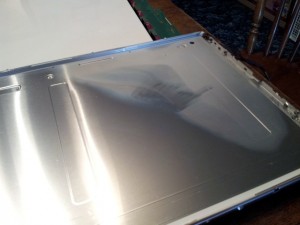
Phosphorus spray on LCD reflective metal backing

The back of the main LCD panel is labeled with a sticker indicating that it is a Samsung LTM230HT01 – which accounts for the quality of the picture; I have always been pleased with Samsung displays.

After removing the reflective metallic backing for the main LCD panel, it quickly became clear that my problem is most likely a broken CCFL tube.  As you can see in the image at right, there is grayish-white residue distributed across the top right corner of the metal backing plate, characteristic of a fluorescent bulb that has broken but is still sufficiently closed to allow it to sputter and leak.  I believe this residue is a combination of phosphorus and mercury that has escaped from the lamp during the few times we tried to get the monitor to kick on again.  Handle with care!

Shortly after removing the back panel, my suspicions were finalized that this is indeed a CCFL problem.  One of the tubes is cracked through and will require replacement.
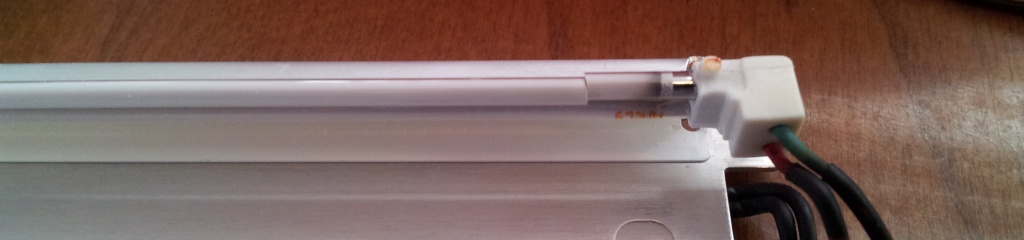
Crack near end of CCFL tube

There’s some good information in this thread about testing and replacement of the components.  I’ve located a couple of potential sources for the CFLs, which are indicated to be 535mm (haven’t confirmed diameter yet)- Plazmo Industries out of Omaha on eBay, CFL Warehouse, and Backlight Company (who appear to stock both 3.0mm and 2.4mm diameter versions).  I haven’t completely ruled out the idea of upgrading from CCFL to LED technology as suggested at lcdparts.net, though they don’t have anything of the correct size and the closest options to it appear prohibitively expensive.  It would also be possible to build an LED strip or matrix myself, but my lack of familiarity with the best performing LEDs in this scenario (for brightness, whiteness, energy consumption, heat dissipation, and lifetime) lead me to avoid such an undertaking.

UPDATE 2012-11-20

Dug out my micrometer and measured in at ~5/64″, or approximately 2mm.  I may have some further searching to do in order to locate a 2mm tube, as I don’t believe any of the ones I ran across previously were that diameter.  Out of curiosity, I also measured the length, and it turned out to be about 20 1/4″, or approximately 515mm between the silicon caps… doesn’t match with what my other sources had indicated.  It might be as much as 20 1/2″ or even 20 5/8″ inside the caps.  Since they will need to come off anyway, I went ahead and peeled back the silicon caps.  Unfortunately I destroyed one in the process… so that partially answers the question on # of CCFL’s to purchase as “at least two” since I will be removing the other one to replace the cap in any case.  The most accurate measure I could come up with is 20 11/16″ from tube end to tube end, which equates to approximately 525mm.  It also appears that they placed a small heat shrink boot over the connections at one end of the tubes, which is also a good idea.

Older Posts »

Powered by WordPress