Landis Vinchattle An aggregation.

November 23, 2013

How to Brew – By John Palmer – What is Malted Grain?

Filed under: Food and Drink,Links — Tags: — Landis V @ 3:42 pm

http://www.howtobrew.com/section2/chapter12.html

I had been thinking about this very question for the past couple of days and hadn’t yet specifically searched it out, so it was great timing to run across this section of Palmer’s book.  I will probably have to buy this one at some point if for no other reason than I keep running into it as a resource or reference as I’m searching.  I’ve probably already seen enough value from the book to justify the purchase price.

November 19, 2013

Constructing a Backyard Half-Barrel Brewery | MoreBeer

Filed under: Fabrication,Food and Drink,Links — Tags: , , — Landis V @ 11:26 pm

http://morebeer.com/articles/building_a_brutus_10_brewery

Quick read, saving in case I ever reach the point where something of this size makes sense.

November 15, 2013

Homebrew Finds: Homebrewing Related Amazon Fillers

Filed under: Food and Drink,Links,To Buy — Tags: — Landis V @ 11:02 am

http://www.homebrewfinds.com/p/homebrewing-related-amazon-fillers.html

Lots of useful stuff here.  I really shouldn’t bookmark it, as that makes it way too easy to come back and spend money…

November 10, 2013

11 Mistakes Every New Homebrewer Makes | The Mad Fermentationist – Homebrewing Blog

Filed under: Food and Drink,Links — Tags: , — Landis V @ 10:19 pm

http://www.themadfermentationist.com/2012/02/11-mistakes-every-new-homebrewer-makes.html

Ran across the above while searching for some basic information about preparing a dry yeast for priming during bottling.  It didn’t have specifically what I was looking for, but there were definitely some useful tips in the article, and more (along with good discussion) in the comments.  The author also has an interesting article on lambics here that should be a good reference in the future when I get a little more experience.

Advanced Bottle Conditioning – Northern Brewer

Filed under: Food and Drink,Links — Tags: , — Landis V @ 7:32 pm

http://www.northernbrewer.com/documentation/AdvancedBottleConditioning.pdf

Some references for C02 volumes of several container types, sugar types, and a variety of priming and re-yeasting methods.

This ties in really nicely with John Palmer’s page on priming and bottling, especially the nomograph here.

October 29, 2013

Chillers

Filed under: Fabrication,Food and Drink,Links — Tags: — Landis V @ 12:12 am

Since my carboys and equipment should arrive between tomorrow and the next day, and Saturday promises to be a brew day, I’m now thinking about chillers.  I’m fairly sure I could borrow one easily, and that is likely to be what I will do.  But at some point I’ll be doing my own brewing in my own garage, and will need a method to rapidly cool wort.  Making a few notes on some of the things I’ve run across while researching the topic so I can find them rapidly when the time comes.

  • Thermodynamics of Chilling
  • Counterflow provides optimal cooling; immersion is simpler and very likely cheaper.  Cleanliness and sterilization is a not insignificant concern in a counterflow chiller.
  • Why?  Reduce dimethyl sulfide which is eliminated from the wort while boiling, but accumulates in the hot wort post-boil until it’s chilled to a level appropriate for fermenting; limit the amount of time wort is in the delicate stage between a sterilizing boil and fermentation with the protection of an airlock and a layer of CO2.
  • Nice, simple build diagram for a basic immersion chiller (maybe use more tubing, had a few thoughts on the subject to increase surface area by possibly incorporating a few verticals.
  • Is there enough variation in temperature to create convection within the wort?  Is there a good way to increase it if so?
  • Chiller built from some thinner diameter tubing, but it doesn’t seem to cool as fast as some of the larger diameter tubing chillers I’ve seen referenced.  May be possible to overcome by pumping from an ice bath?
  • Combination whirlpool/immersion chiller.
  • An article with some of the formulas useful in calculating and improving the efficiency of the heat exchange.
    • Thinner walled tubing is better.  I had been pondering this, but now that I write it down it makes complete sense.  You want the heat to transfer from the wort to the coolant as quickly as possible, and any other medium that the heat has to travel through will impede that.
    • Other thoughts
      • As the wort and cooling medium approach an equilibrium, heat transfer becomes less efficient.  I’m not sure it’s logarithmic, but it’s true that the greater the difference in temperatures, the more efficient the transfer.
      • Only a small amount of the cooling medium within the chiller actually contacts the transfer medium (i.e., copper tube) itself.   Heat will equalize in the cooling medium very quickly due to turbulence.  Does this have an effect that would be relevant to the nominal diameter of the tubing and/or volume to surface area ratio of the tubing?
      • Assuming, I believe accurately, that the temperature of the cooling medium will very rapidly approach the temperature of the wort (i.e., in the first few inches of tubing submerged in the wort), would there not be a benefit to running a split system with several coils like the Hydra in addition to a couple of large volume short length exchangers to cool very rapidly during the initial phase?
      • Flow within the chiller itself – should the cooling medium flow from top-to-bottom or bottom-to-top through the chiller?  Much like a water heater, I would expect the wort temperature to vary from hottest at the surface to coolest at the base, with the exception of a whirlpool chiller which would tend to equalize temperature throughout.  I’m not sure how great this temperature variation would be, though it’s probably realistically too small to even bother considering in a homebrew scenario. (This could also be achieved to some extent by increasing the flow rate of the cooling medium if practical, but may still prove less effective, during the very early phases, over a 20 or 25′ length of tube.)

October 26, 2013

The gravity of beer…

Filed under: Food and Drink,Mathematics,Science,Uncategorized — Tags: — Landis V @ 4:15 pm
Having a "little" beer.

Having a “little” beer… but not the one under measurement.

I borrowed a hydrometer and tested the gravity of the beer I’ve had bubbling away in a carboy in my basement since early May.  Yes, it has actually been running that long.  I’ve heard from a few folks that the wort (donated by a local brewery) was on the rich side.  Seems we’re getting close to finishing up now, not a lot of bubbling but still a few now and then.

The measurements were taken on 10/26/13 with the wort (is it still technically wort after five months and nearing the end of the process?) around 65°.  Unfortunately I don’t have an original gravity reading right now, but I hope to get one from someone else who worked with wort of the same lineage after next Saturday.

Watching the beer develop has piqued my interest enough that I’ve placed some orders with Midwest Supplies and Northern Brewers.  You can read up on the gravity calculations and how the alcohol content of the final product here if you are interested.  I’m still very much a novice, but the process is interesting enough I might actually take the time to see if I can understand all the influences involved – air and liquid temperature, densities of the initial and finished product, and several others I probably wouldn’t have thought about initially.

We sampled the uncarbonated beer after the measurements, and the flavor is unique but not bad.  There’s enough jalapeno in it that you get the flavor without the burn.  Somehow it comes across to me as having a salty taste.  Looking forward to bottling it in the near future and eventually seeing how it comes out once it has some carbonation.
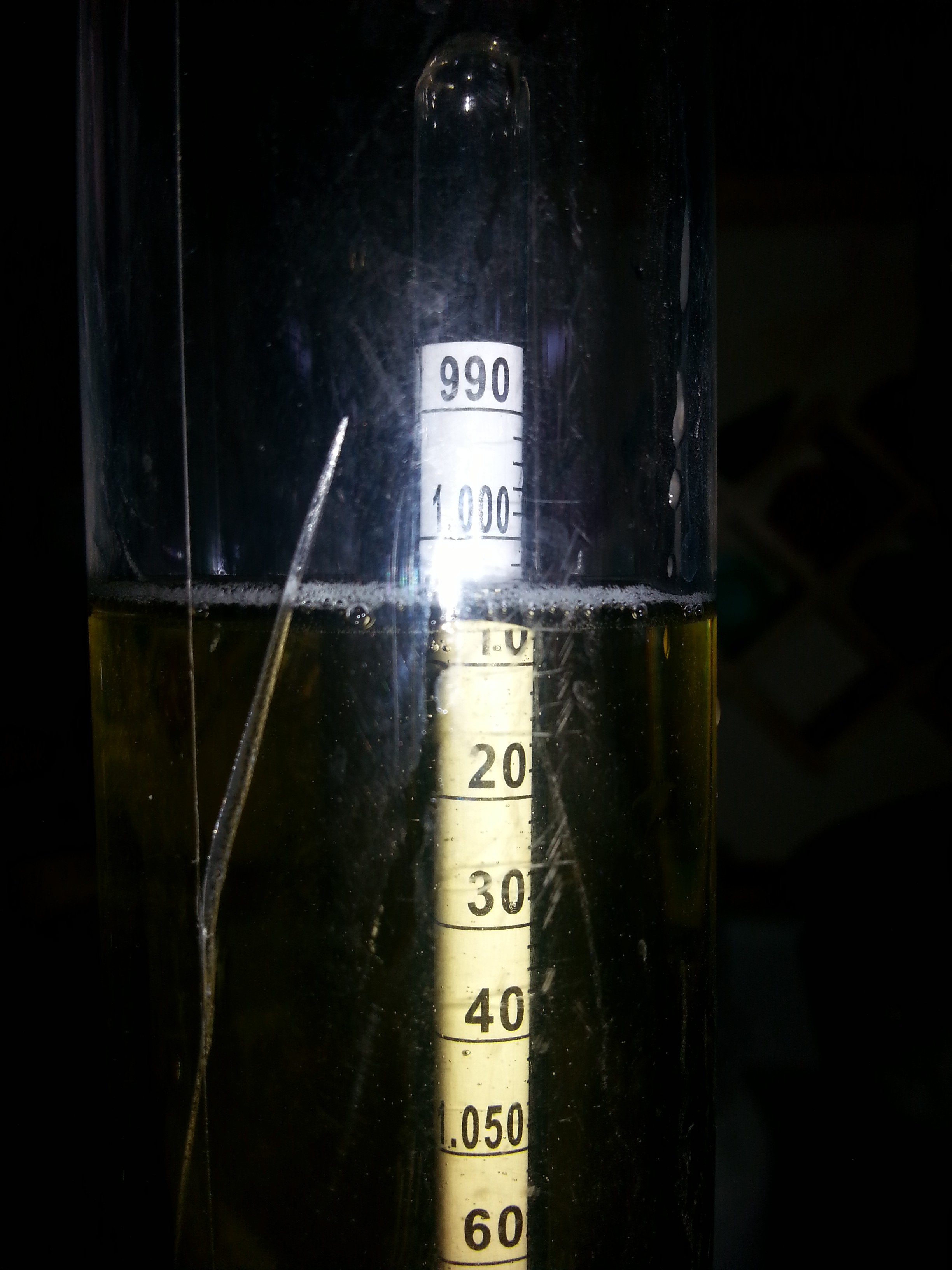
Gravity reading from 10/26/13 near the end of fermentation on my first batch of beer.  Wort around 65°, better picture than the previous one.

Gravity reading from 10/26/13 near the end of fermentation on my first batch of beer. “Wort” around 65°.
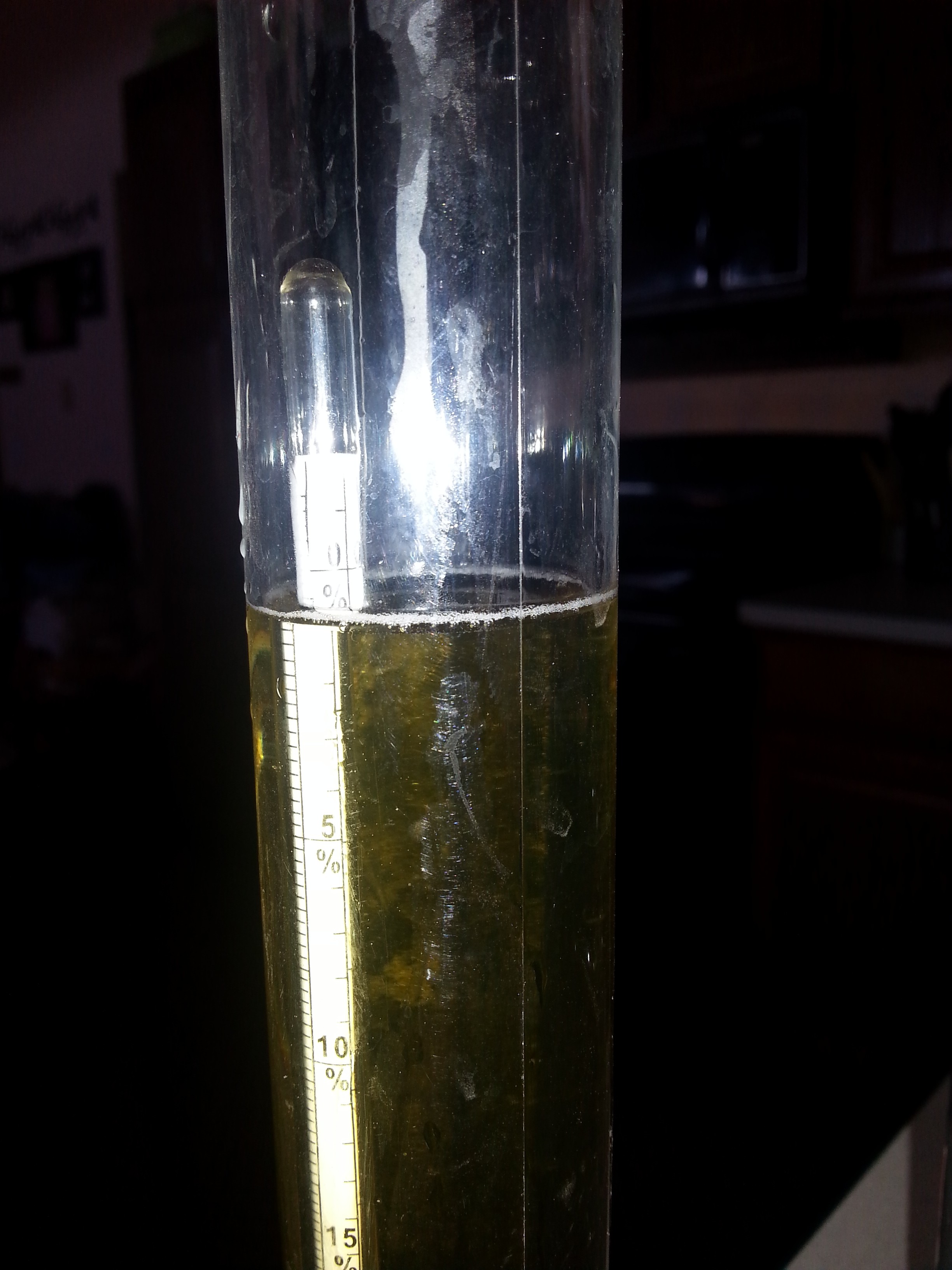
Potential alcohol reading on the hydrometer, 10/26/13.  There's not a whole lot of "potential" left.

Potential alcohol reading on the hydrometer, 10/26/13. There’s not a whole lot of “potential” left.

« Newer Posts — Older Posts »

Powered by WordPress